June in the Vegetable Garden

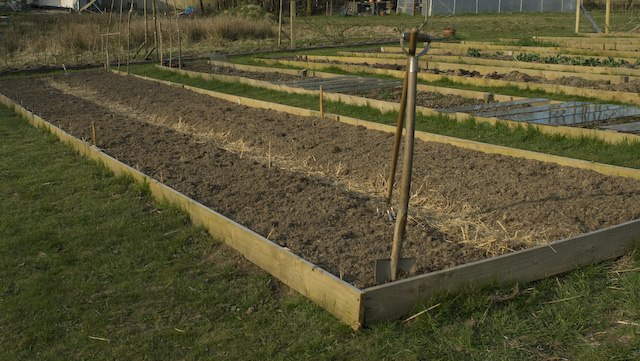
Well it’s been a little while since our last blog update, but the explosion of  life that has happened out there in the meanitime has kept us a little distracted.  It serves me right really. I remember saying in May how good it was that, this year we were on top of things, after two hard years of getting the land back into  shape. And then things really started to grow. Which is great, obviously. When  you’re managing the land for both wildlife and food production, things growing is  clearly a good thing. But all the stuff growing where you don’t need it to grow,  takes up as much, if not more, of our time as the things we’re nurturing. With a vegetable patch the size of ours, even just mowing the paths in between the raised beds takes a while.

The potatoes and asparagus that we planted at Easter are now doing really well,  despite the pretty serious lack of rain in the meantime and the late frost that  nipped the tops of some of the spuds that decided to make an early dash for it.  The leeks that we planted seem to be settling in nicely too.Whereas in previous  years here, we haven’t had to worry about watering outside, we are having to do a  bit. The newly planted asparagus crowns probably would have died without a bit of  water early on. And now that some of the potatoes are starting to flower, it’s  worth thinking about watering them to help the tuber growth. It’s good to pick the  flowers off too. For the most part we are using the water out of the ducks’ pond,  which is quite rich in nitrogen because of, well you know what, but we have had to  get the hose out as well. Our approach is generally to try to restrict watering to  the early growth stages and then to give things an occasional really good soak.  This allows the water to deeply penetrate the soil and encourages the plants’  roots to follow it down.

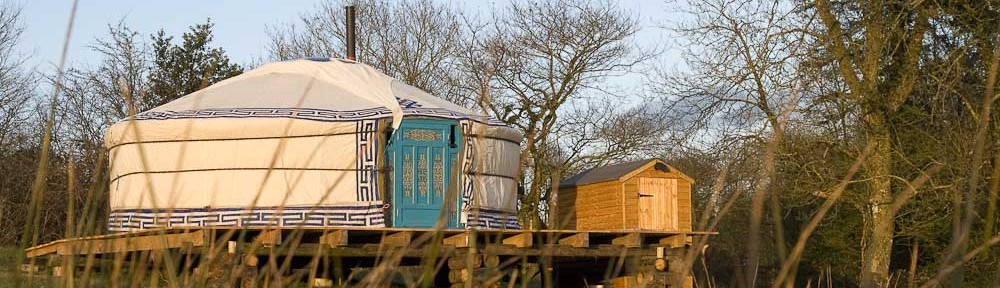
Most of our onions have been harvested now. Lots of shallots. Lyndsey has been  curing them over the last week. That’s essentially involved spreading the whole  plants out in wooden crates and letting them dry naturally on the dining table in  the yurt. The onions were dried slighltly differently. They were gently lifted and  just left to sit on the ground until the stems went dry. I think we may well now  have just about enough onions to last until the next lot are ready. The garlic  that we planted in the Autumn is looking nice and plump now. We couldn’t resist  and picked one recently, but it wasn’t quite ready. The cloves hadn’t fully  separated, but it was really tasty nonetheless. Won’t be long.

We’ve planted purple sprouting broccoli outside; a favourite of ours that will  produce its lovely florets around March next year. We’ll probably plant some salad  leaves amongst the broccoli; it’s a good use of the space while the broccoli is  still relatively small, yet large enough to provide some protection to the tender  lettuce leaves. We’ve also planted a couple of varieties of summer squash outside,  hoping that we have more favourable conditions for them than last year.

Our strawberries have been a big success this year, despite the ones outside  having been chewed to the ground by the herd of red deer that pass through  occasionally. Having created a mesh cloche to protect them, they’ve made a good  recovery and produce enough fruit for us to have a good handful each every day. The currants, both red and black, are just beginning to ripen, and it won’t be  long before the gooseberries are sweet enough to pick. There are loads of summer  raspberries forming now and the bees have really loved their flowers this year,  though they are still some way off being ready. Soooo looking forward to that!

Wow, all that great produce and I haven’t even mentioned the polytunnel…
New Lawnmower

With almost nine acres to manage and no grazing animals to help, there is quite a bit of grass cutting of one sort or another to be done. I’m pretty sure we’ll be returning to this subject in the future – lots of times. But today is a ‘special’ day because I finally succumbed and bought a proper lawnmower. I’m sure a few people will wonder how we managed for the last two years, but we are quite good at just managing with what we have. Anyway when it comes to cutting the grass, we have a range of other tools to suit the variety of types of grass maintenance that happens out here: a kick ass brushcutter, which sees a lot of action; a number of Austrian scythes; a little push cylinder mower thing, that really doesn’t cut it; oh, and the tractor of course.

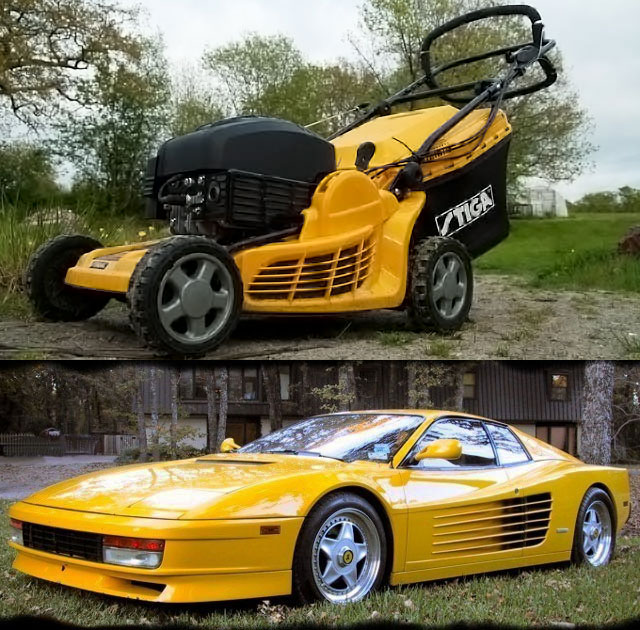
Yellow lawnmower that thinks it's a Testarossa

Yellow lawnmower that thinks it's a Testarossa

But today is for the new lawnmower. It’s one of those purchases we didn’t really want to make, but just had to. So we thought about how much we wanted to spend and then pretty much doubled it to get something half decent that is going to do the job (and take all the rough treatment we will no doubt give it). And we got lucky, thanks to the fab people at the local, independent lawnmower shop: http://www.ieuanevanssonlimitedllandeilo.co.uk/ They really did do us a good deal and we got a much higher spec machine than we thought we’d get for the money. It’s a Stiga 47s, galvanised and self propelled, with the ability to collect cuttings or mulch the grass up finely and put it back into the ground. All good. It’s got a nice quiet engine too, that’s supposed to be nice and efficent. So as far as petrol lawnmowers go, it looks like it scores reasonably on the environmentally friendly front. I suppose the way you use them is important in considering the overall impact of the machine though…

And so…

The mower is primarily for mowing the paths between the vegetable beds. In the Summer it needs doing every week. With the little push thing that we had, it was just impossible because the grass would soon be too long for it and usually it would be wet from the rain, which further hindered our ability to cut it. I was resorting to using the brush cutter, which really isn’t the tool for the job. Cutting the grass paths in the vegetable garden has the huge benefit of providing a fantastic mulching material for round the plants. When spread on the beds, the grass cuttings suppress weeds and retain moisture; a thoroughly fantastic use of a ‘waste’ product. If and when we get to the point of covering all the beds with clippings, we can compost them, or just use the mower’s mulching function and return them to the grass to provide a bit of fertiliser.

We’ll also use the mower round the yurt to provide us with a bit of a lawn to roll around on and for friends to camp on etc. It’s also going to come in really handy down in tipi hollow and the shrubbery. I’m sure we’re (actually, most likely I’m) going to get a lot of use out of it.

Oh and the lawnmower is yellow and looks like a Ferrari Testarossa. Ridiculous or what? Why?

The Veg Patch

When we lived in the city we had ourselves an allotment, we loved it and we learnt so much from those around us, from books and just from trial and error (or sheer bloody mindedness). Now we have a really large allotment to play with, plus an orchard. It has taken two years of hard slog and effort to get to where we are now, however we did learn some cunning tricks along the way. We worked our guts out to get the polytunnel up and the first beds functioning, however once we got the bare minimum in order we changed tack a little. We also have a meadow to manage and that we cut late in the autumn, as we are

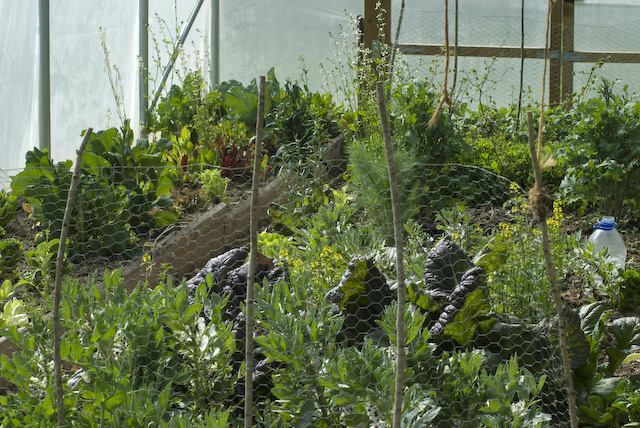
The Polytunnel in April

The Polytunnel in April

managing it as a flower rich meadow we cut it too late for good hay, but it does leave us with a lot of grass! We therefore decided to use it as a mulch which we then covered with a semi permeable black liner. After twelve months we ended up with  beautiful crumbly soil that is very rich and great to work with, it is also stacked full of worms, aerating the soil and giving it its wonderful texture. We are on a clay, so a fair amount of our land is bog or wet woodland, where the vegetable garden is it is protected from the worst of the elements, it used to have the muck heaps on from horses and is about the driest area, plus it was mainly grass when we arrived so we didn’t feel like we were ruining a lovely habitat. Now we have an orchard of about twenty apple, pear, cherry and plum trees and six functioning beds; I am so looking forward to this years harvest!

The Veg Patch

The Veg Patch